
Front of House Lighting Ideas That Actually Elevate Your Home's Exterior
June 1, 2024
The good news is that exterior lighting is one of the highest-leverage design decisions a homeowner can make. A few deliberate fixture choices, like the right sconce flanking a front door or lights guiding the way through a garden, can completely transform how your home presents itself to the world.
This guide covers the most effective outdoor lighting ideas along with the placement and colour temperature guidance to help you make the best choices for your home.
Why Most Front of House Lighting Falls Flat
The default approach to exterior lighting is to install a porch light above the front door and call it done. That single overhead fixture creates flat, harsh light directly at the entry while leaving all the other features of your home in darkness.
Good outdoor lighting ideas help you work in layers, just like interior lighting. There's ambient light to establish the overall scene, accent lighting to highlight architectural features and landscaping, and task lighting to guide movement safely along walkways and steps. When all three layers are working together, the exterior feels intentional as any room inside your house.
The other mistake is colour temperature. Cool white bulbs (anything above 3000K) read as clinical and cold against a residential exterior. They drain warmth from natural materials like brick, timber, and stone, and make landscaping look flat. Warm white bulbs in the 2700K to 3000K range are the correct choice for every zone of the home's exterior. At 2700K, the light shifts warmer as it dims, moving toward candlelight, creating the effect you want for an inviting front entry.

Statement Front Door Lighting
The front door is the focal point of any home's exterior, and the lighting around it should reflect that. Two wall sconces flanking the entry is the classic approach for a good reason: They frame the door symmetrically, create balanced light on either side, and establish visual weight.
Fixture size matters here. The instinct is always to go conservative, but undersized sconces flanking a front door are too small to hold their own against the architecture. A general rule: the fixture height should be roughly one-quarter to one-third the height of the door opening. On a standard 8-foot door, that means a sconce 24 to 32 inches tall. Scale up for taller entries or double-height porticos.
MOD Lighting's Ember wall sconces are a great way to bring this kind of presence to a front entry. The geometric form reads clearly against a facade even in daylight, and the warm brass finish works with natural materials and colors.
Keep in mind, asymmetric homes call for asymmetric solutions. A single large sconce to one side of an off-centre door often reads better than forcing symmetry where the architecture doesn't support it.
Sconce Placement Height
Install exterior wall sconces at 66 to 72 inches from the ground, roughly eye level when standing at the entry. Mounting too high pushes the fixture out of visual range and creates awkward shadows on the face. Too low, and it gets lost against the surrounding landscaping or furniture.
For homes with covered porches, a pendant centred above the entry adds a second layer of interest and works especially well when the ceiling height allows for a generous drop. Coordinate the pendant and sconce finishes for a cohesive look.

Architectural Uplighting and Facade Lighting
The facade of your home is its largest visible surface at night, and it deserves more than a single porch light's spill. Directional uplights placed at the base of the home create depth and drama that completely changes how the house reads after dark.
Uplighting works by directing a narrow beam at a vertical surface from a low angle. A smooth render wall benefits from tight-beam uplighting at the corners to define the form. Stone or brick responds to grazing light, fixtures placed close to the surface and angled sharply upward to show the texture.
The key is to resist over-lighting. A facade hit with too many fixtures at too high intensity creates a flattening glare. Two or three well-placed directional spots do more than a dozen undirected floods. Complement the places you choose to uplight with a balanced wall lamp, like Mod Lighting's Dawn.
Uplighting Trees and Tall Landscaping
Mature trees at the front of a property are among the most effective landscape lighting opportunities. Uplighting placed at the base of a large tree illuminates the canopy from below for a dramatic silhouette. The shadows from the branches cast complex patterns around them for a unique texture.
Moonlighting achieves the opposite effect. Lights placed high in the tree's canopy and aimed downward recreate the quality of natural moonlight filtering through branches. The resulting shadows on your lawn have a similar softness.
Landscape Lighting Ideas for the Front Yard
Front yard lighting serves two functions at once: it makes moving around your property at night much safer, and it makes a home feel complete. Path lights, ground-level accent fixtures, and step lights all contribute to this layer.

Path Lights
Path lights are low-mounted downward-facing fixtures that illuminate walkways and driveway edges. They should be primarily practical, preventing trips, and guiding guests to the front door, but their spacing and style have a major effect on how the front yard reads as a whole.
Space lights 8 to 12 feet apart along a straight walkway. Stagger them alternately on either side of the path rather than placing them in matched pairs to create a more natural rhythm and prevent the runway effect. The Meadow path light collection is perfect for a subtle, modern look.
Solar lights are a practical option for areas far from power runs. Position them closer together than hardwired fixtures (generally 6 to 8 feet) since the light output is lower.

Step Lights
Any change in level at the front of the property, like steps up to a porch, raised garden bed edging, or a split-level driveway, will benefit from dedicated step lighting. Recessed step lights placed into the riser (the vertical face of each step) cast a downward wash of light that reveals the edge of each tread clearly without creating glare.
The Chaz step light collection is designed with this exact need in mind. The recessed profile means the fixture disappears into the architecture during the day, and at night it delivers focused light precisely where movement happens. Install at every step change in level, not just the first and last.
Ground Lights and Well Lights
Ground-embedded well lights are flush with the paving or lawn surface and direct light upward. They're the most discreet light source option to draw attention to trees, pillars, or facade features since there's no above-ground fixture to manage or obstruct mowing. Around driveways and garden beds, they define edges cleanly without the visual weight of a mounted fixture. However, they require more effort and cost to install around your home, and don't allow for the easy changes or adjustments that other lighting fixtures can.
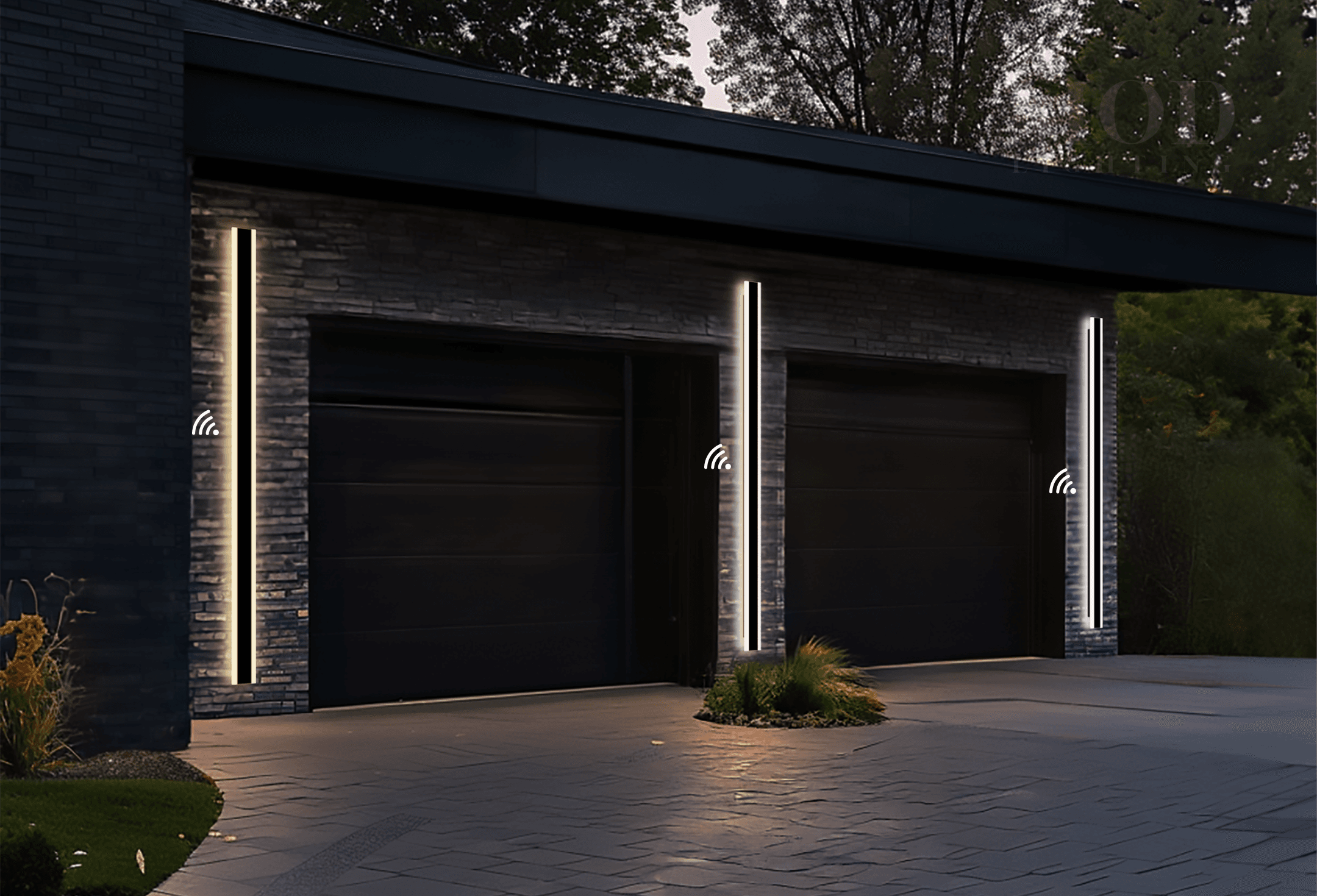
Garage Door Lighting
The garage door occupies a significant portion of most homes' street-facing facade, yet it's the zone most often neglected in exterior lighting plans. Leaving it unlit creates a large dark mass that pulls the eye for the wrong reasons.
Mounting lighting by the garage door panel frames the opening and ties the lighting across the facade together. The fixtures don't need to be identical to the front door sconces, but they should coordinate. Match finish (black, brass, nickel) and ensure the scale is proportional to the door height.
Avoid floodlights above the garage as the primary lighting solution. High-intensity floods create glare rather than light, and the harsh downward cast flattens the architecture below. If security is the concern, a motion-sensing fixture like Mod Lighting's Haylen at a controlled lumen level serves the same function without the harsh visual.

String Lights and Ambient Porch Lighting
String lights make all the difference in transforming a covered porch or pergola entry into a genuinely inviting outdoor space.
The most common mistake with string lights is going too bright. Filament-style Edison bulbs at lower wattages, like G40 or G30 globe bulbs, produce the warm, diffused quality that reads as atmospheric rather than just functional. Bulbs in the 2700K range are correct here; anything cooler reads as clinical against the softer materials of an outdoor living space.
For a permanent installation, hardwired string lighting with a dimmer gives precise control over the mood. A dimmable circuit means the same string of lights can serve as welcoming ambiance in the early evening and a low, intimate glow later in the night.
Compliment your string lights with mounted fixtures like Mod Lighting's Gleam ambient light, and moveable, energy-efficient LED lanterns like Beam.

Smart Outdoor Lighting
Dimmable smart fixtures allow the front of house lighting to shift between scenes: a bright, welcoming configuration for when guests arrive and a lower, security-focused setting for overnight. Motion-sensitive smart fixtures at the garage and side entries add security without the aesthetic intrusion of permanent floods.
The Haylen range brings smart capability to outdoor wall and ceiling fixtures without the utilitarian look that often accompanies smart exterior products. Adjustable colour temperature means the same fixture can produce a warm 2700K glow for evening entertaining or a slightly crisper 3000K for task situations.
Automating the lighting schedule eliminates the single most common exterior lighting mistake: leaving the porch dark when it should be welcoming. Set the lights to turn on at dusk and step down to a lower setting at a specified hour.

Colour Temperature for Exterior Lighting
Colour temperature is the most overlooked decision in exterior lighting, and it has the greatest impact on how the whole scheme feels.
For all residential exterior lighting: front entry, porch, path lights, garage, landscape uplighting, stay within the 2700K to 3000K range. This is warm white light. It flatters natural materials, and creates an inviting, residential glow.
2700K is the warmer end. At this temperature, the light has a golden quality that intensifies as it dims. It's ideal for porches, string light installations, and any zone where atmosphere is the priority.
3000K is slightly crisper. Good for garage lighting or areas where a degree of task clarity is useful without tipping into the blue-white range that reads as cold.
4000K and above, cool white, daylight, has no place in residential exterior lighting. It produces a blue-tinted cast that makes stone and timber look grey, and kills the warmth of any landscape planting.
If you want to get lighting in the right color temperature that also adds color to your home, check out our Haylen RGB range for waterproof, weather-resistant customizable lights.
Fixture Scale and Proportion
Exterior fixture scale follows the same logic as interior fixture sizing, and the same mistake applies: most homeowners choose too small. A fixture that looks imposing in a product image or showroom setting will often disappear against a real home's facade.
For wall sconces flanking the front door, the fixture height should be one-quarter to one-third the door height. On a standard 8-foot door (96 inches), that's a 24 to 32-inch fixture. On a grander double-height entry, scale up with the same proportions.
For post lights at the driveway entrance or along a long path, taller is almost always better. Post lights at 5 to 6 feet read clearly from a distance and establish a visual anchor for the whole front yard without being overwhelmed by landscaping.
Creating a Cohesive Front-of-House Lighting Design
Individual lighting elements, like the porch sconces, the path lights, and the uplights, work best when they form a coherent whole. Cohesion doesn't require identical fixtures across every zone. You just need some consistency in finish and colour temperature.
Choose one or two finishes and hold them across all exterior fixtures. Black and brass are both versatile finishes that work well with a wide range of architectural styles.
Consistent colour temperature across your lighting is the most important part. A mix of 2700K path lights and 4000K garage floods creates a glaring look. Every exterior source should sit within the 2700K to 3000K band.
Avoid unlit gaps. A well-lit front entry with an unlit garage and dark garden beds reads as incomplete. The eye travels between light and dark zones, and large dark areas pull attention away. Work from the entry outward, adding layers until the whole front yard glows in a consistent lighting scene.
Explore MOD Lighting's outdoor collection to find fixtures that bring these layers together, with statement entry sconces, landscape path lights, and lights for outdoor entertainment designed to work as a complete exterior lighting system.